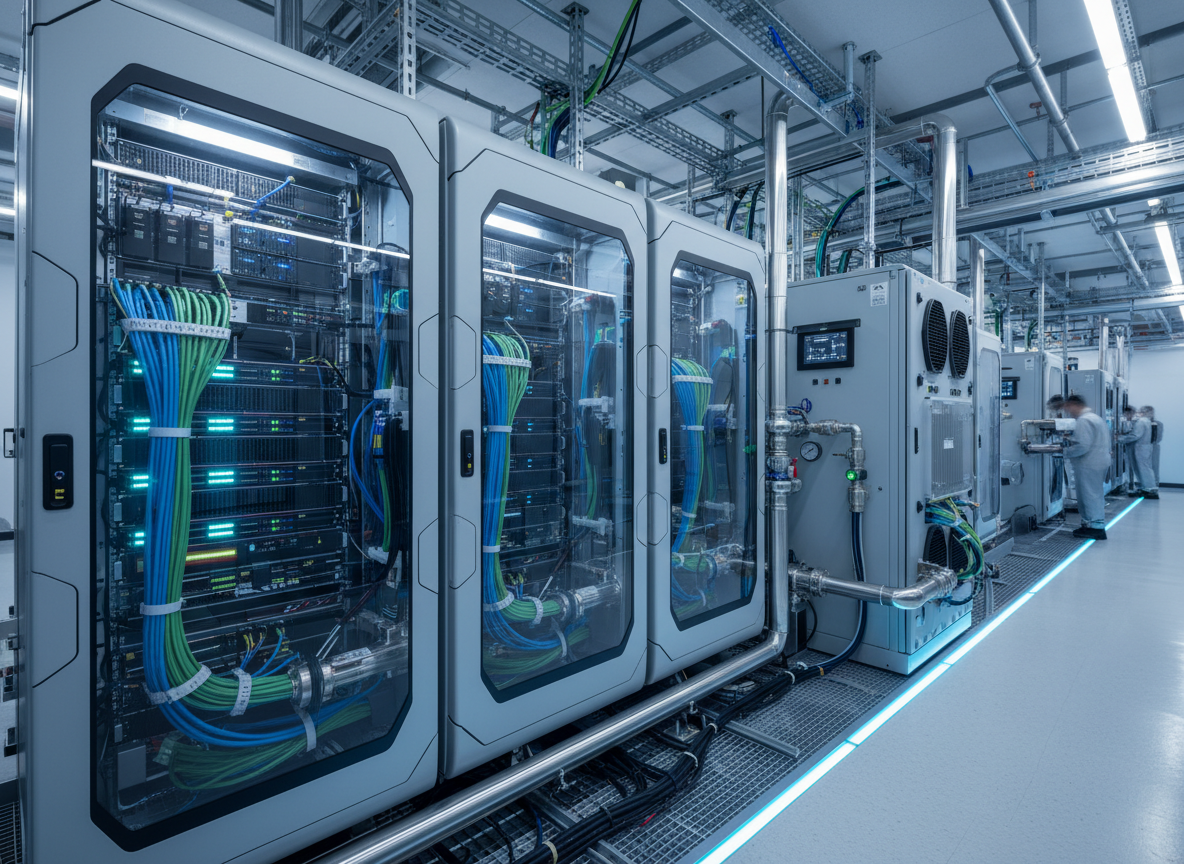
As rack densities increase, particularly in AI and HPC deployments, liquid cooling is increasingly considered for high-density deployments where air cooling alone may not be sufficient or practical for the project's thermal requirements. Liquid cooling infrastructure spans a range of approaches, including direct-to-chip cooling, rear-door heat exchangers, and immersion systems, each with different equipment, piping, and facility-interface requirements. Modular infrastructure can be configured to house the mechanical equipment, distribution piping, and interface points these systems require.
A central component in many liquid cooling architectures is the coolant distribution unit (CDU), which manages the interface between the facility's cooling water or refrigerant loop and the liquid delivered to IT equipment. Modular mechanical buildings can be configured to house CDUs and associated pumps, along with the secondary cooling loops, piping runs, and leak detection systems that liquid cooling architectures typically require. Facility-water interfaces — connecting the module's cooling systems to the site's chilled water or condenser water supply — are a key coordination point between the modular infrastructure and the broader site cooling plant.
Maintenance access is a specific design consideration for liquid cooling infrastructure, since these systems require deliberate maintenance-access planning, with service clearances and inspection provisions based on the equipment and cooling architecture selected for the project, and leak detection and containment provisions are typically built into the module design accordingly. Because liquid cooling technology and IT equipment interfaces continue to evolve, modular configurations are often planned with adaptability in mind, recognizing that no single liquid cooling design applies uniformly to every facility.
Data Center Modular manufactures liquid cooling infrastructure modules based on specifications provided by the buyer's mechanical engineering team, and delivers them internationally. We do not perform mechanical system design, CDU selection, or on-site installation and commissioning of cooling equipment — those remain the responsibility of the buyer and their specialist mechanical contractors.
Technician insight
Liquid cooling technology and equipment interfaces are evolving quickly, and a specification that is current when a project starts can shift before fabrication is complete. Confirming which interface points and dimensions are truly fixed, versus which may still change, early in the specification process tends to reduce coordination issues later on.
Liquid Cooling Infrastructure Modules Services We Offer
✓CDU Housing Modules
Modular mechanical buildings configured to house coolant distribution units and associated pumping equipment.
✓Direct-to-Chip Cooling Interface Modules
Infrastructure configured to support the distribution piping and interfaces required for direct-to-chip liquid cooling systems.
✓Secondary Loop Distribution Modules
Modules housing the piping and distribution infrastructure for secondary cooling loops between facility water and IT equipment loops.
✓Leak Detection and Containment Modules
Infrastructure configured with leak detection and containment provisions specified for liquid cooling applications.
✓Hybrid Air-Liquid Cooling Modules
Configurations supporting facilities using a combination of air and liquid cooling strategies.
✓Facility-Water Interface Modules
Modular infrastructure configured to interface with site chilled-water or condenser-water systems as specified.
How it works
- 1
Project Requirement Review
We review the liquid cooling architecture, equipment specifications, and facility-water interface requirements provided by your mechanical engineering team.
- 2
Configuration to Specification
The module is configured around your specified CDU placement, piping routes, leak detection requirements, and maintenance access needs.
- 3
Factory Manufacturing
We manufacture the modular components according to the confirmed technical specifications.
- 4
Quality Control and Testing
Manufactured modules undergo quality control and testing against the agreed specifications before shipment.
- 5
International Delivery
Modules are delivered internationally, concluding our involvement prior to on-site installation and mechanical commissioning.