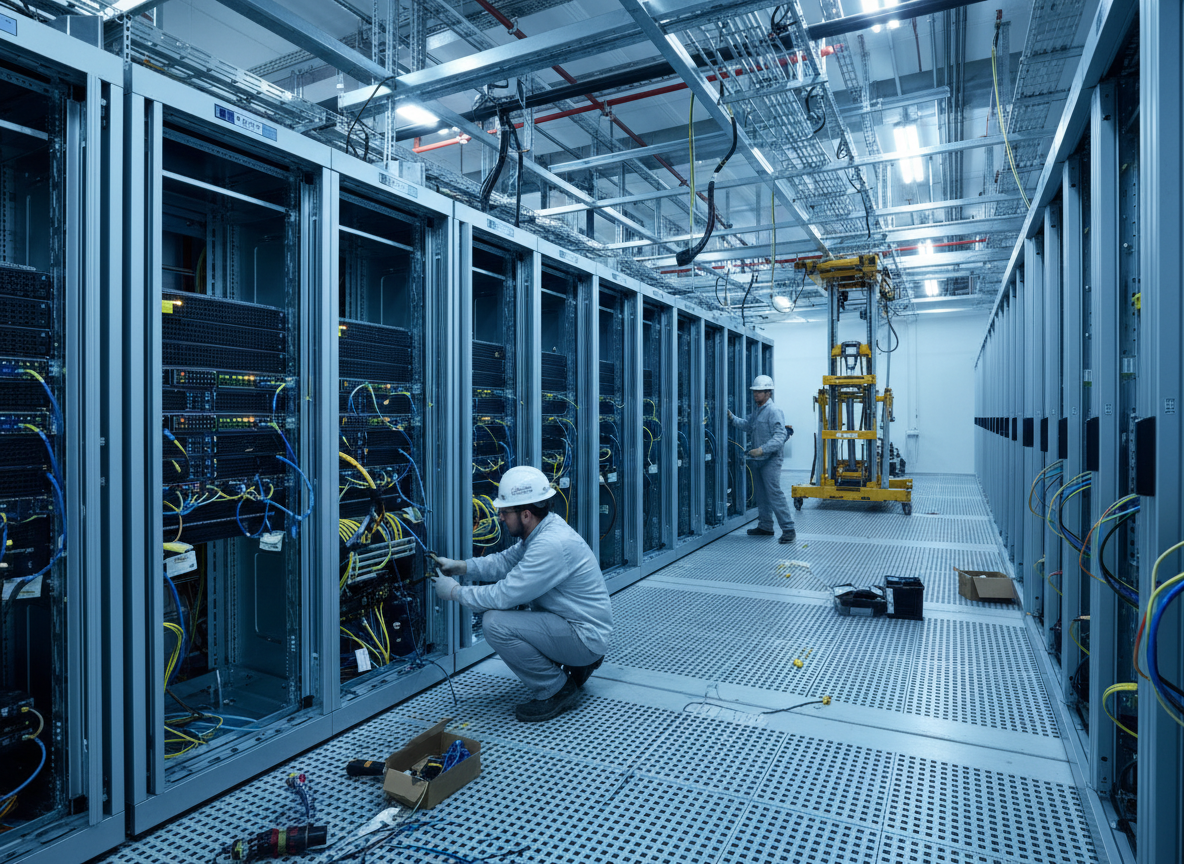
Data Center Modular specializes in the design and fabrication of purpose-built expansion modules, providing a strategic solution for scaling data center capacity. These modules are engineered to integrate with existing facilities, offering a flexible alternative to traditional brick-and-mortar construction. Each unit is a self-contained environment, housing critical IT infrastructure, power distribution, cooling systems, and fire suppression, all pre-tested and ready for deployment. Our approach focuses on minimizing on-site construction time and disruption, allowing for faster capacity additions and reduced project risk. We work with data center developers, EPC firms, and engineering teams to ensure that each module meets the specific performance, environmental, and structural requirements of their projects, from initial concept through to delivery.
Our expansion modules are designed with a high degree of configurability to address diverse operational demands. Typical configurations include dedicated IT whitespace modules, power utility modules, and advanced cooling modules, often combined to form a comprehensive data center expansion. These units can be specified with various power densities, cooling technologies (e.g., direct expansion, chilled water, evaporative cooling), and redundancy levels to align with application criticality. Structural considerations include seismic ratings, wind loads, and integration points for existing building envelopes or standalone deployments. We provide detailed documentation for mechanical, electrical, and plumbing interfaces, facilitating straightforward integration into a larger data center ecosystem and ensuring compatibility with site-specific conditions and operational protocols.
Integration considerations are paramount in the successful deployment of data center expansion modules. Our engineering support includes detailed interface specifications for electrical connections, chilled water or refrigerant lines, data network conduits, and building management system (BMS) integration. We focus on ensuring that the module's internal systems—such as power distribution units (PDUs), uninterruptible power supplies (UPS), and computer room air handlers (CRAHs)—are compatible with the client's existing infrastructure. This includes evaluating voltage requirements, cooling capacities, and network topology to prevent bottlenecks or inefficiencies. The objective is to deliver a solution that not only adds capacity but also operates cohesively within the client's broader data center strategy, maintaining operational continuity and performance standards.
Key Considerations for Data Center Expansion Modules
When evaluating modular expansion, several factors are critical for project success. These include the long-term scalability roadmap of the facility, the specific power and cooling density requirements for anticipated IT loads, and the environmental conditions of the deployment site. For example, sites in regions like Ashburn, with its distinct four seasons, require robust thermal management systems designed to perform efficiently across a wide range of ambient temperatures. Additionally, considerations such as security protocols, access control, and physical resilience against local environmental factors (e.g., humidity fluctuations, seismic activity if applicable) must be integrated into the module's design. Our team collaborates closely with project stakeholders to address these nuances, ensuring the delivered modules are not just functional, but optimized for their intended operational lifespan and environmental context.
Technician insight
In Ashburn, the thing that catches most people out with Data Center Expansion Modules is often the ground conditions. The local geology, with its prevalence of expansive clay soils, means that foundation design and proper site preparation are critical. If not adequately addressed, differential settlement can lead to structural issues down the line, regardless of how robust the module itself is. It's a detail that can easily be overlooked if you're not deeply familiar with the regional soil characteristics.
Data Center Expansion Modules Services We Offer
✓High-Density IT Modules
Pre-engineered modules optimized for high-density compute and storage, featuring advanced cooling and power distribution to support demanding workloads.
✓Power Utility Modules (PUMs)
Self-contained units housing switchgear, transformers, UPS systems, and generators, designed to provide resilient and scalable power infrastructure.
✓Cooling Distribution Modules (CDMs)
Dedicated modules for efficient cooling infrastructure, including chillers, evaporative coolers, or direct expansion units, tailored to site-specific climate conditions.
✓Edge Data Center Units
Compact, ruggedized modules ideal for deploying compute capacity closer to the source of data generation, supporting low-latency applications.
✓Telecom Shelter Modules
Secure, climate-controlled enclosures for telecommunications equipment, designed for remote or challenging environments requiring robust infrastructure.
✓Customized Hybrid Modules
Integrated solutions combining IT, power, and cooling elements within a single module, configured to unique project specifications and space constraints.
✓Secure Containerized Solutions
ISO-standard container-based modules offering enhanced physical security and rapid deployment for temporary or permanent data center needs.
How it works
- 1
Initial Consultation & Requirements Definition
We begin with a detailed discussion to understand your project's technical specifications, capacity needs, site constraints, and integration requirements. This phase establishes the foundation for the module's design.
- 2
Conceptual Design & Engineering
Our engineering team develops a conceptual design, including preliminary layouts, power and cooling schematics, and structural considerations, incorporating your feedback for refinement.
- 3
Detailed Design & Fabrication Planning
Once the conceptual design is approved, we proceed with detailed engineering, creating comprehensive fabrication drawings and a bill of materials. This phase includes specifying all components and systems.
- 4
Module Fabrication & Assembly
The module is constructed in our controlled facility, where all structural elements, electrical systems, cooling infrastructure, and IT racks are integrated and pre-assembled according to the approved design.
- 5
Factory Acceptance Testing (FAT)
Before shipment, the module undergoes rigorous Factory Acceptance Testing to verify all systems function as specified, ensuring quality and performance prior to leaving our facility.
- 6
Logistics & Delivery
We coordinate all logistics for transportation, ensuring the module is safely and efficiently delivered to your specified site, ready for installation and final integration.
Pricing
The cost of a Data Center Expansion Module is influenced by several key factors, including its overall dimensions and structural design requirements. The complexity and type of integrated equipment, such as high-density IT racks, specialized power distribution, or advanced cooling systems, significantly impact the final price. Electrical and cooling capacity requirements, along with the chosen level of redundancy, also play a crucial role. Custom finishes, security features, and specific environmental controls can add to the cost. Furthermore, the quantity of modules ordered, the destination for delivery, and the logistics involved, as well as the project's schedule and lead time requirements, all contribute to the overall investment.