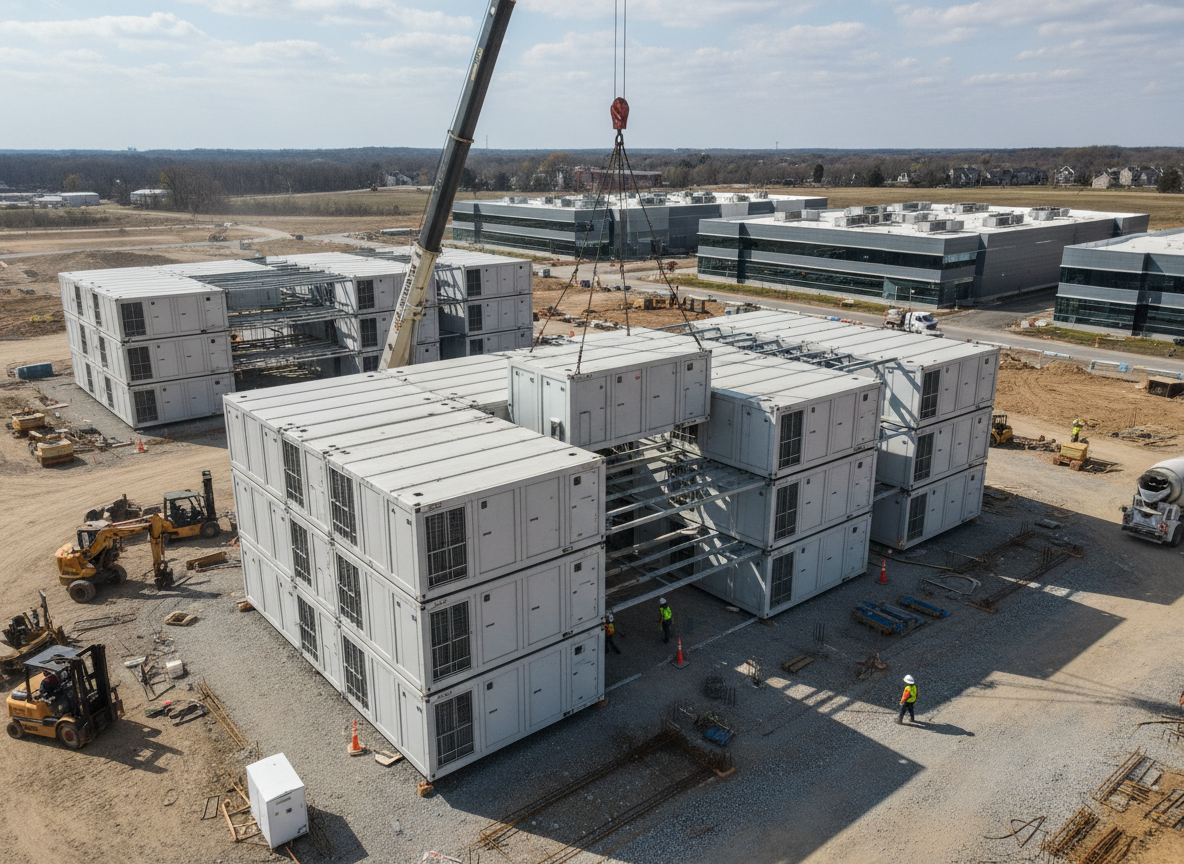
Modular data center buildings represent a strategic solution for organizations seeking accelerated deployment, predictable performance, and scalable infrastructure. These factory-built, pre-integrated structures are designed to house critical IT equipment, power distribution, cooling systems, and fire suppression within a self-contained, weatherproof enclosure. Unlike traditional stick-built construction, modular buildings significantly reduce on-site construction time and associated risks, allowing for faster time-to-market. Data Center Modular specializes in delivering these purpose-engineered structures, working with project teams to define requirements, optimize configurations, and ensure compatibility with existing or planned site infrastructure. Our solutions are designed for a wide range of applications, from edge computing deployments and temporary capacity expansion to permanent enterprise data centers and colocation facilities, providing a flexible foundation for evolving IT demands.
Typical configurations for modular data center buildings range from single-module deployments to multi-module campuses, interconnected to form larger, integrated facilities. These buildings can be configured as 'white space only' shells, ready for client-specific IT fit-out, or delivered as 'turnkey' solutions with pre-installed racks, power distribution units (PDUs), uninterruptible power supplies (UPS), and various cooling methodologies such as direct-to-chip liquid cooling, in-row cooling, or perimeter CRAC/CRAH units. Structural considerations often include seismic bracing, ballistic protection, and specialized acoustic dampening, depending on the operational environment and security requirements. Integration considerations extend to mechanical and electrical interfaces for site utility connections, network demarcation points, and building management system (BMS) integration, ensuring cohesive operation within a broader data center ecosystem.
The journey from concept to deployment for a modular data center building involves meticulous planning and execution. Data Center Modular collaborates with engineering, procurement, and construction (EPC) firms, general contractors, and data center developers to align the modular solution with overall project objectives. This includes detailed discussions on power density requirements, cooling strategies, physical security protocols, and future expansion plans. Our manufacturing process adheres to stringent quality control standards, ensuring that each module is built to precise specifications and undergoes comprehensive factory acceptance testing (FAT) before shipment. This rigorous approach minimizes on-site commissioning efforts and accelerates the transition to operational readiness, delivering a reliable and high-performance data center environment tailored to specific project needs.
Technician insight
In Ashburn, the thing that catches most people out with Modular Data Center Buildings is often the local permitting process for specialized structures, especially concerning utility easements and tie-ins. The high water table and occasional seismic activity in the region also necessitate careful foundation design and structural considerations that can impact overall site preparation timelines.
Modular Data Center Buildings Services We Offer
✓Edge Data Center Modules
Compact, self-contained modules optimized for rapid deployment in remote or distributed locations, bringing compute power closer to data sources and end-users.
✓High-Density Compute Modules
Engineered for demanding workloads, these modules integrate advanced cooling and power solutions to support high-density rack configurations and specialized hardware.
✓Scalable Colocation Facilities
Multi-module designs that allow for phased expansion of colocation space, providing flexibility for service providers to grow capacity as customer demand increases.
✓Secure Government & Defense Modules
Robustly constructed modules with enhanced physical security features, electromagnetic shielding, and environmental controls for sensitive government and defense applications.
✓Power & Cooling Infrastructure Modules
Dedicated modules housing critical power generation, UPS systems, switchgear, and advanced cooling plant equipment, designed to support adjacent IT modules.
✓Hybrid Cloud Interconnect Modules
Modules designed to facilitate secure and low-latency interconnections between on-premises infrastructure and various public cloud environments, supporting hybrid IT strategies.
How it works
- 1
1. Requirements Definition & Design
Collaborate with your project team to meticulously define technical specifications, including power density, cooling methodology, physical dimensions, and environmental controls. Our engineers develop detailed architectural and engineering drawings for your review and approval.
- 2
2. Fabrication & Integration
Once designs are approved, modules are fabricated in a controlled factory environment. This includes structural assembly, installation of electrical, mechanical, and fire suppression systems, and integration of IT infrastructure components as specified.
- 3
3. Factory Acceptance Testing (FAT)
Each module undergoes rigorous factory acceptance testing to verify functionality, performance, and adherence to design specifications. This includes power-on tests, cooling system validation, and control system checks to ensure readiness for deployment.
- 4
4. Quality Assurance & Documentation
Upon successful FAT, a comprehensive quality assurance review is conducted. All relevant documentation, including as-built drawings, operational manuals, and test reports, is prepared for handover.
- 5
5. Logistics & Shipping Preparation
Modules are securely prepared for transport. This involves internal bracing, weatherproofing, and coordination with specialized logistics providers to ensure safe and efficient delivery to your designated site.
- 6
6. Site Delivery
The fully fabricated and tested modular data center building is delivered to your project site, ready for final placement, utility connections, and commissioning by your local teams.
Pricing
The cost of a modular data center building is influenced by several key factors. These include the overall dimensions and structural design, the complexity and density of integrated equipment (e.g., UPS, cooling systems, racks), specific electrical and cooling capacity requirements, internal and external finishes, the quantity of modules ordered, the final destination, logistical challenges, and the project schedule.