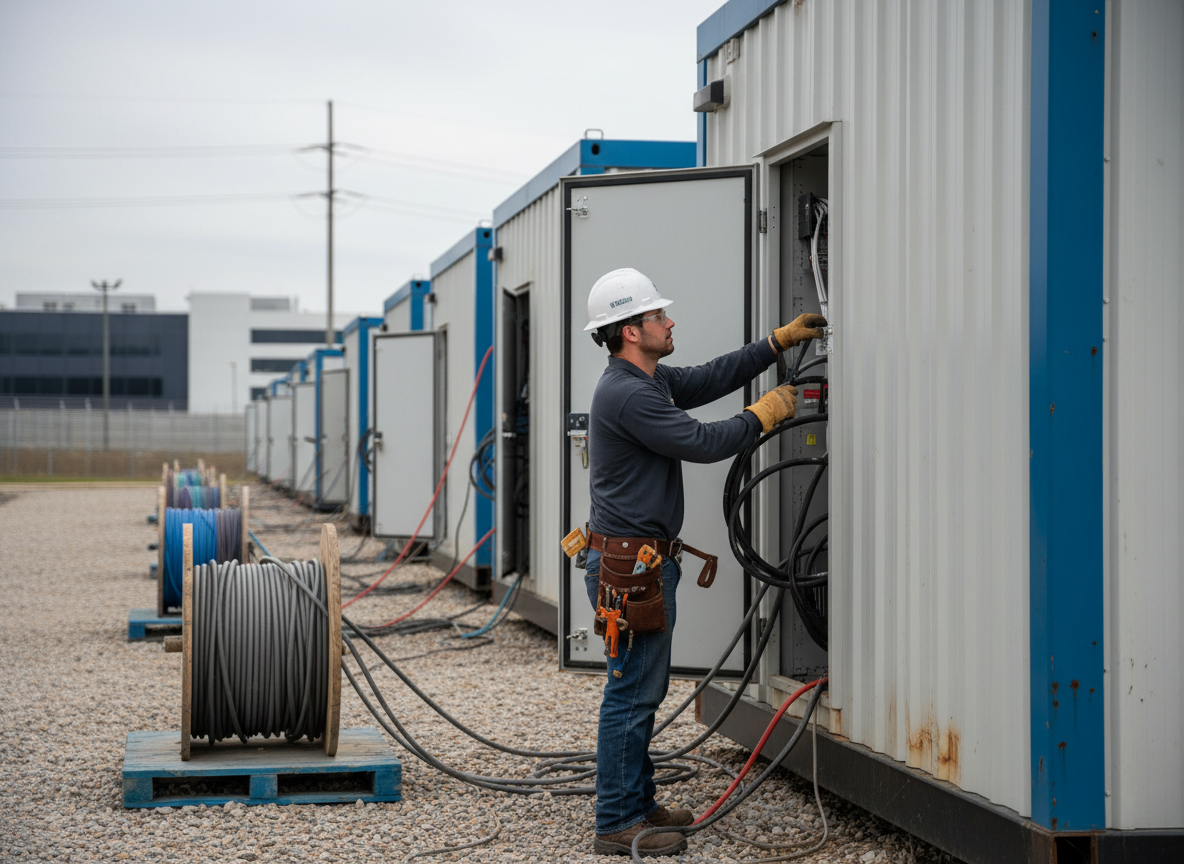
Modular Electrical Buildings from Data Center Modular offer a streamlined approach to deploying critical power infrastructure for data centers. These purpose-built, factory-integrated structures are engineered to house medium voltage (MV) and low voltage (LV) switchgear, transformers, uninterruptible power supplies (UPS), battery systems, and associated control and monitoring equipment. By pre-fabricating these complex systems off-site, projects can significantly reduce on-site construction time, mitigate weather-related delays, and enhance quality control through a controlled manufacturing environment. Our modular solutions are designed to meet stringent data center reliability and redundancy requirements, providing a robust and predictable foundation for power distribution and protection.
Typical configurations for our Modular Electrical Buildings are highly adaptable to project-specific demands. We regularly deliver units housing MV switchgear for utility interconnection and primary distribution, LV switchgear and panelboards for facility power, and comprehensive UPS/battery modules for critical load protection. These buildings can also incorporate integrated fire suppression, environmental monitoring, and access control systems, creating a complete, secure enclosure for sensitive electrical assets. Considerations for structural design often include seismic ratings, wind loads pertinent to the final destination, and provisions for future expansion or equipment upgrades, ensuring long-term adaptability and resilience.
Integration considerations are paramount for successful deployment. Data Center Modular works with project teams to ensure seamless interfaces with the broader data center infrastructure. This includes coordinating electrical tie-in points, data network connectivity for Building Management Systems (BMS) and Data Center Infrastructure Management (DCIM), and mechanical interfaces for cooling and ventilation. While Data Center Modular focuses on the delivery of the complete modular unit, we provide detailed documentation and support to facilitate efficient on-site integration by the client's contractors. This collaborative approach minimizes potential conflicts and ensures that the modular electrical building functions as an integral part of the overall data center ecosystem from day one.
The decision to utilize Modular Electrical Buildings is often driven by the need for accelerated deployment schedules, enhanced quality assurance, and predictable project costs. For data center developers and EPC/GC firms, this solution bypasses many of the challenges associated with traditional stick-built construction, such as labor availability, site congestion, and sequential trade coordination. The factory-controlled environment allows for parallel construction of the building and integration of electrical systems, significantly compressing the overall project timeline. Furthermore, comprehensive factory acceptance testing (FAT) prior to shipment provides a high degree of confidence in system functionality and performance, reducing commissioning risks on-site.
Technician insight
In Ashburn, the thing that catches most people out with Modular Electrical Buildings is often the precise coordination of utility interconnection points and the local permitting for larger electrical services. The sheer density of data centers here means utility infrastructure is robust but also highly utilized, requiring meticulous planning and often longer lead times for new service connections than anticipated.
Modular Electrical Buildings Services We Offer
✓MV Switchgear Buildings
Purpose-built enclosures designed to house medium voltage switchgear, providing primary power distribution and protection for data center utility feeds and internal MV loops.
✓LV Switchgear & PDU Buildings
Modular units integrating low voltage switchgear, panelboards, and power distribution units (PDUs) to manage and distribute power to critical IT loads and facility infrastructure.
✓UPS & Battery Buildings
Self-contained structures engineered to house uninterruptible power supply (UPS) systems and associated battery arrays, ensuring continuous power to critical data center equipment during utility outages.
✓Generator Control Enclosures
Prefabricated buildings designed to house generator control panels, automatic transfer switches (ATS), and paralleling gear, optimizing backup power system management.
✓E-Houses (Electrical Houses)
Comprehensive modular electrical houses integrating multiple power components like switchgear, transformers, and motor control centers into a single, self-contained unit.
✓Renewable Energy Integration Modules
Specialized modular buildings designed to integrate and manage power from renewable energy sources, such as solar or wind, into the data center's electrical grid.
How it works
- 1
Design & Engineering Coordination
We collaborate with your engineering and design teams to finalize layouts, equipment specifications, and interface requirements. This phase ensures the modular building perfectly aligns with your overall data center architecture and electrical schematics.
- 2
Structural & Electrical Fabrication
Our manufacturing facility constructs the building shell, including structural elements, roofing, flooring, and environmental controls. Simultaneously, electrical components such as switchgear, UPS units, and cabling are integrated according to approved designs.
- 3
System Integration & Cabling
All specified electrical equipment is meticulously installed, interconnected, and cabled within the modular building. This includes power wiring, control wiring, and network cabling for monitoring systems.
- 4
Factory Acceptance Testing (FAT)
A rigorous Factory Acceptance Test (FAT) is performed to verify all systems and components operate as specified. This includes functional testing of electrical systems, environmental controls, and safety features, often with client representatives present.
- 5
Logistics & Transportation Planning
Following successful FAT, the modular electrical building is prepared for transport. This involves securing all internal components, weatherproofing, and coordinating specialized logistics for delivery to your designated site.
- 6
Delivery to Site
The completed modular electrical building is delivered to your project site, ready for placement on its prepared foundation and subsequent connection to site utilities and the broader data center infrastructure.
Pricing
The cost of a Modular Electrical Building is influenced by several critical factors. Primary considerations include the overall dimensions and structural design, which must account for the equipment housed and the environmental conditions of the final destination. The complexity and quantity of integrated equipment—such as the type and rating of switchgear, UPS systems, and transformers—significantly impact the price. Electrical and cooling requirements, including specialized HVAC systems or redundant cooling, also play a role. Custom interior finishes or specific security enhancements can add to the cost. The total quantity of units ordered and the final delivery destination, along with the project schedule, are also key determinants.