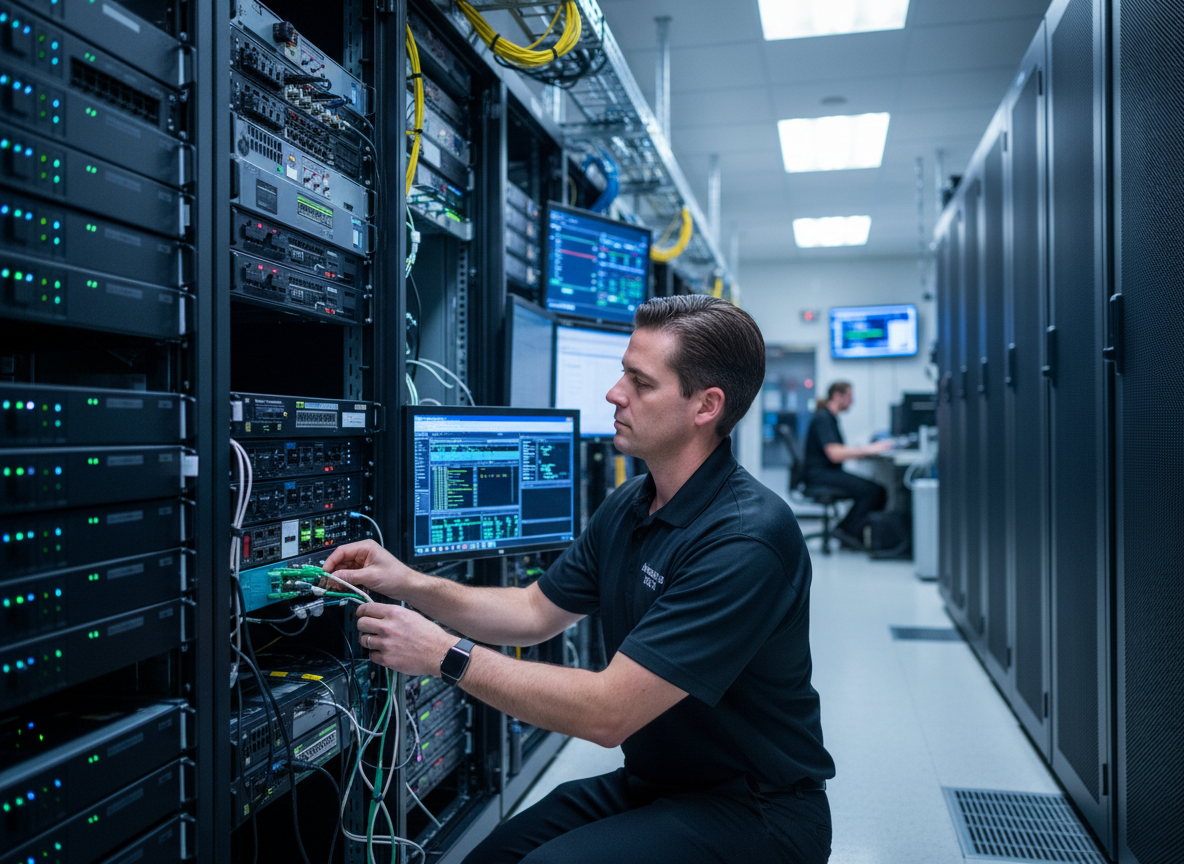
Network Operations Center (NOC) Modules from Data Center Modular deliver a dedicated, secure, and environmentally controlled space for monitoring, managing, and troubleshooting data center operations. Designed for rapid deployment, these modules integrate critical infrastructure components such as advanced environmental controls, uninterruptible power supplies (UPS), fire suppression, and comprehensive security systems. Each module is engineered to provide a resilient operational hub, minimizing the on-site construction complexity and accelerating time-to-operation for new or expanding data center facilities. We focus on delivering a high-quality, factory-integrated solution that meets the stringent demands of continuous IT infrastructure management.
Our NOC modules are highly configurable to meet diverse operational requirements. Typical configurations include dedicated workspaces for operators, secure equipment racks for monitoring hardware, and integrated audiovisual systems for real-time data visualization. We accommodate various power densities and cooling strategies, from precision air conditioning to hot/cold aisle containment, ensuring optimal conditions for sensitive monitoring equipment and personnel comfort. Structural designs can be tailored for specific environmental loads, including seismic considerations, and can incorporate enhanced security features such as ballistic-rated panels or advanced access control systems, providing a robust and secure operational environment.
Integration considerations are paramount in the design of our NOC modules. We work with project teams to ensure seamless interfaces with existing data center infrastructure, including power distribution, network connectivity, and building management systems (BMS). Our modules are designed for efficient connection to site utilities, simplifying the final commissioning process. While we provide the integrated modular solution, successful deployment requires careful coordination with site-specific engineering for foundation design, utility tie-ins, and local permitting. Data Center Modular focuses on delivering a complete, tested module, ready for final site integration and operational handover, streamlining the path to a fully functional Network Operations Center.
Considerations for Project Teams
When evaluating Network Operations Center Modules, project teams often weigh factors such as deployment speed, scalability, and the ability to maintain operational continuity during expansion or relocation. Our modular approach significantly reduces on-site construction timelines and minimizes disruption to existing operations. For projects requiring phased deployment or future expansion, our modules offer inherent scalability, allowing additional units to be integrated as operational needs evolve. Furthermore, the controlled factory environment ensures consistent build quality and rigorous testing, leading to a more predictable performance outcome compared to traditional stick-built construction. This predictability is crucial for maintaining the high availability standards expected of a modern data center's operational core.
Technician insight
In Ashburn, the thing that catches most people out with Network Operations Center Modules is often the ground conditions. The clay soils here, especially with the region's freeze-thaw cycles, can be surprisingly reactive. This means that foundation design for a modular unit, even if it's 'just' a NOC, needs careful attention to avoid differential settlement down the line, which can impact internal alignments and sensitive equipment.
Network Operations Center Modules Services We Offer
✓Standard NOC Modules
Pre-engineered modules providing essential monitoring infrastructure and operator workspaces for rapid deployment in various data center environments.
✓High-Density Monitoring Modules
Designed for environments requiring extensive rack space for monitoring equipment, offering enhanced power and cooling capabilities within a compact footprint.
✓Secure Access NOC Modules
Modules featuring advanced physical security measures, including reinforced walls, biometric access control, and integrated surveillance systems for sensitive operations.
✓Disaster Recovery NOC Modules
Configured for rapid deployment in emergency scenarios, providing essential monitoring and control capabilities for business continuity planning.
✓Integrated Command & Control Modules
Advanced modules combining NOC functionality with broader command and control capabilities, often including video walls and collaborative workspaces.
✓Edge Data Center NOC Modules
Compact and robust modules optimized for remote or edge deployments, designed to withstand varied environmental conditions while maintaining operational integrity.
How it works
- 1
Initial Consultation & Requirements Definition
We engage with your project team to understand the specific operational requirements, desired capacity, environmental conditions, and integration points for your Network Operations Center Module.
- 2
Conceptual Design & Specification
Based on the defined requirements, our engineering team develops a conceptual design, outlining the module's layout, infrastructure components, and preliminary specifications for review and refinement.
- 3
Detailed Engineering & Fabrication
Upon design approval, detailed engineering drawings are produced, and the module enters the fabrication phase in our controlled manufacturing facility, integrating all specified power, cooling, and monitoring systems.
- 4
Factory Acceptance Testing (FAT)
The completed module undergoes rigorous Factory Acceptance Testing (FAT) to verify all systems and components function according to specifications, ensuring quality and performance before shipment.
- 5
Logistics & Delivery Preparation
Following successful FAT, the module is prepared for transport, including secure packaging and coordination of logistics to its final destination, ensuring safe and timely arrival.
Pricing
The cost of a Network Operations Center Module is influenced by several key factors. Module dimensions and structural design, including any specialized load requirements or seismic ratings, play a significant role. The complexity and type of integrated equipment, such as specific UPS configurations, cooling unit capacities, and advanced monitoring hardware, also impact pricing. Electrical infrastructure requirements, including input voltage, distribution panels, and redundancy levels, along with the chosen cooling strategy (e.g., direct expansion, chilled water), are major determinants. Interior finishes, acoustic treatments, and specialized security enhancements contribute to the overall cost. Finally, the quantity of modules ordered, the final destination, and the project's schedule and logistics complexity will affect the total investment.