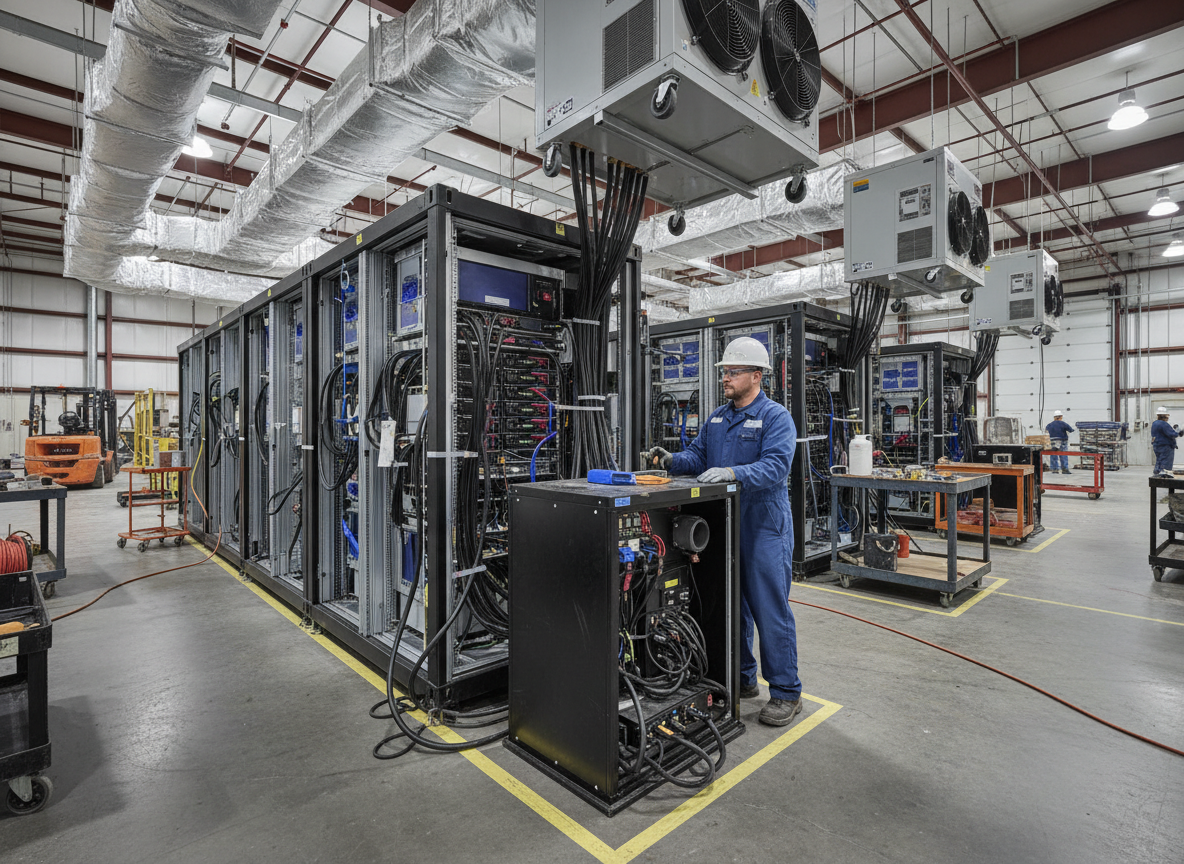
Temporary and interim data center infrastructure solutions offer a strategic advantage for projects requiring rapid, flexible, and scalable compute capacity without the long-term commitment of permanent construction. These modular systems are designed for quick deployment and redeployment, making them ideal for bridging capacity gaps during new facility construction, supporting phased build-outs, or providing disaster recovery and swing space during renovations. Unlike traditional stick-built facilities, modular units are manufactured off-site in controlled environments, ensuring consistent quality and accelerated delivery schedules. This approach minimizes on-site disruption, reduces construction timelines, and provides a predictable path to operational readiness, allowing project teams to maintain critical IT operations or launch new initiatives on an aggressive schedule.
Data Center Modular provides robust, pre-engineered solutions that integrate essential data center components such into a self-contained, transportable unit. Configurations typically include power distribution units (PDUs), uninterruptible power supplies (UPS), precision cooling systems, fire suppression, and environmental monitoring, all optimized for efficiency and reliability. These modules can be deployed as standalone units or interconnected to form larger, scalable temporary data center facilities. Integration considerations primarily revolve around site preparation for utility connections (power, data, cooling water if applicable) and ensuring adequate space for deployment and maintenance access. Our solutions are designed to be compatible with standard IT racks and equipment, providing a seamless transition for hardware installation and commissioning upon arrival.
The inherent flexibility of temporary and interim modular infrastructure allows for precise alignment with project phases and evolving capacity needs. For instance, during the construction of a hyperscale facility, these modules can provide early-stage compute resources for commissioning and testing new network segments or application deployments. In renovation scenarios, they offer a 'hot swap' capability, allowing critical operations to continue uninterrupted while existing infrastructure is upgraded or replaced. Key considerations for procurement teams include assessing the required power density, cooling capacity, physical dimensions for transport and site placement, and the duration of the interim deployment. Data Center Modular focuses on delivering robust, reliable infrastructure that can withstand the rigors of temporary deployment and provide consistent performance throughout its operational lifecycle.
Use Cases for Temporary and Interim Data Center Infrastructure
Project teams often evaluate temporary and interim modular data center infrastructure for several critical scenarios where agility and speed are paramount. For instance, a large-scale data center developer embarking on a multi-phase campus build might use these modules to bring initial compute capacity online rapidly, allowing for early revenue generation or critical application testing before the permanent structures are fully commissioned. This strategy mitigates the financial impact of construction delays and provides a flexible buffer against unforeseen project timeline shifts. Another common use case involves enterprise organizations undergoing significant data center consolidation or modernization. Instead of a 'big bang' cutover, temporary modules can serve as swing space, allowing IT teams to migrate workloads incrementally, test new environments, and decommission old infrastructure without service disruption. This phased approach reduces risk and provides a controlled environment for complex transitions. Furthermore, for organizations requiring compute capacity for a specific, time-bound project, such as a major research initiative, seasonal demand surge, or a large-scale event, temporary modules offer a cost-effective alternative to building out permanent infrastructure that would later be underutilized.
Technician insight
In Ashburn, the thing that catches most project teams out with temporary and interim data center infrastructure is often the ground conditions and local permitting for temporary structures. The clay-rich soils common in the region can require more substantial temporary foundations than anticipated, even for a short-term deployment. Furthermore, while the modular units themselves are manufactured off-site, local jurisdictions in Loudoun County still have specific requirements for temporary utility connections and site safety inspections, which can add unexpected lead time if not factored into the initial project schedule.
Temporary and Interim Data Center Infrastructure Services We Offer
✓Rapid Deployment Modules
Pre-engineered, self-contained modular units designed for immediate deployment to address urgent capacity needs or unexpected outages, minimizing downtime and accelerating time-to-operation.
✓Swing Space Data Centers
Flexible, interim data center solutions providing critical compute capacity during facility renovations, upgrades, or consolidations, ensuring business continuity without service interruption.
✓Construction Phase Support Modules
Temporary infrastructure deployed during new data center construction to support early-stage IT requirements, commissioning, and validation, enabling phased project completion and accelerated go-live.
✓Disaster Recovery & Redundancy Units
Transportable, self-sufficient modules offering rapid recovery capabilities and additional redundancy, designed to be quickly deployed in response to unforeseen events or as part of a robust DR strategy.
✓Edge Computing Interim Solutions
Compact, ruggedized modular units suitable for temporary edge deployments, providing localized compute and storage for specific projects or remote site requirements.
✓High-Density Interim Pods
Specialized modular configurations optimized for high-power density applications, delivering intensive compute capacity for interim periods or specific project workloads.
✓Modular Office & Control Rooms
Complementary modular units providing temporary workspace, monitoring, and control facilities adjacent to interim data center deployments, ensuring on-site operational support.
How it works
- 1
Initial Consultation & Requirements Definition
Our team engages with yours to thoroughly understand project scope, capacity needs (power, cooling, space), deployment duration, site constraints, and specific IT equipment requirements. This phase defines the functional specifications for your temporary infrastructure.
- 2
Solution Design & Configuration
Based on the defined requirements, Data Center Modular engineers design a tailored modular solution. This includes selecting appropriate module types, internal layouts, power distribution, cooling systems, and integration points for external utilities.
- 3
Detailed Quotation & Specification Review
We provide a comprehensive quotation detailing the proposed modular solution, including technical specifications, dimensions, and estimated lead times. This allows for a thorough review and any necessary adjustments before manufacturing.
- 4
Manufacturing & Quality Assurance
Upon agreement, your modular data center infrastructure is manufactured in a controlled factory environment. Each component undergoes rigorous testing and quality assurance checks to ensure compliance with design specifications and performance standards.
- 5
Logistics & Delivery Coordination
Our logistics team coordinates the transportation of the completed modular units to your designated site. This includes managing specialized freight, permits for oversized loads, and ensuring timely delivery to align with your project schedule.
- 6
Pre-Delivery Documentation & Support
Prior to delivery, we provide comprehensive documentation, including detailed drawings, connection diagrams, and operational guides, to assist your site preparation and local installation teams.
Pricing
The cost of temporary and interim modular data center infrastructure is influenced by several key factors. The physical dimensions and structural design of the modules, including any specialized reinforcement or environmental ratings, play a significant role. The type and quantity of integrated equipment, such as UPS systems, precision cooling units, and fire suppression, directly impact the overall price. Electrical requirements, including total power capacity, redundancy levels, and specific voltage configurations, are also critical determinants. The complexity of internal finishes and security features, if specified, will affect costs. Furthermore, the total quantity of modules ordered, the destination location, logistical challenges for transport, and the required delivery schedule all contribute to the final investment.