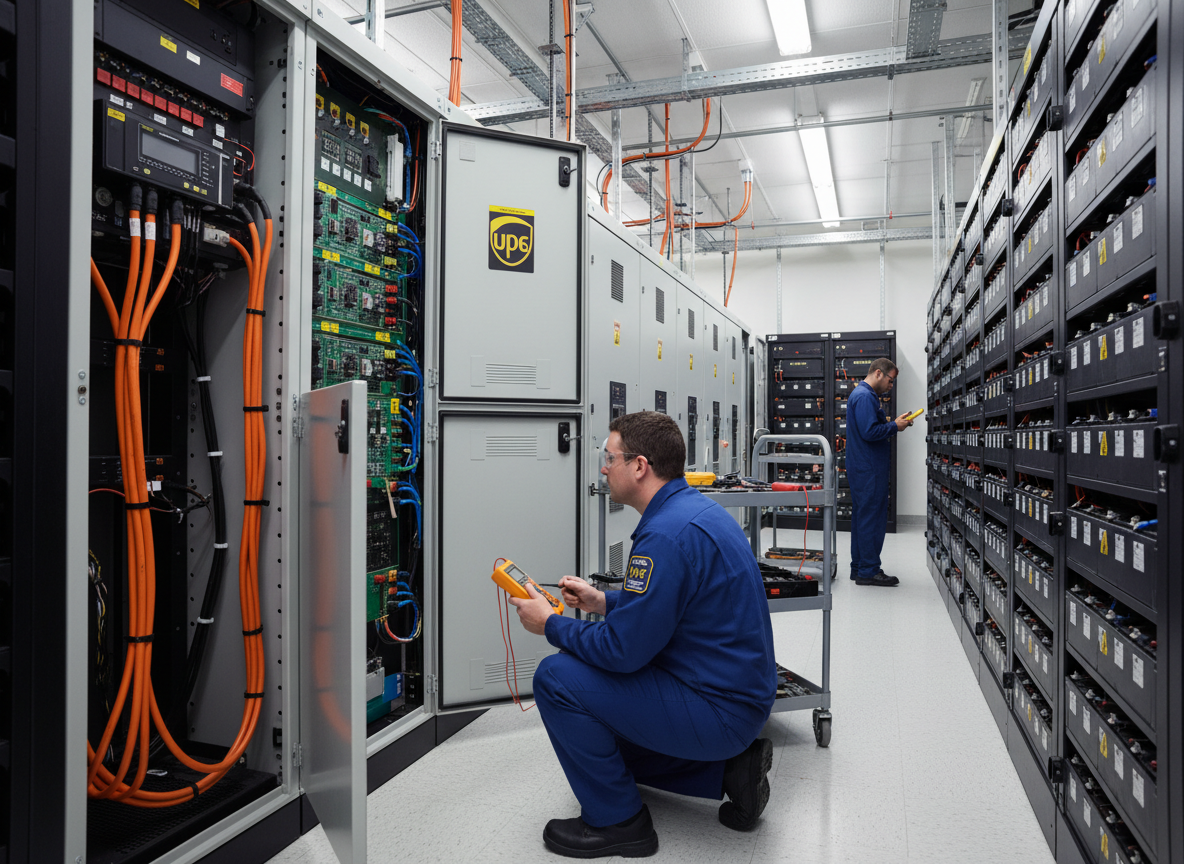
Data Center Modular specializes in the design and fabrication of modular UPS and Battery Room solutions, providing a controlled environment for critical power infrastructure. These modules are engineered to house various UPS topologies, battery chemistries (e.g., VRLA, Li-ion), and associated power distribution units (PDUs), switchgear, and monitoring systems. Our approach focuses on offsite construction, which significantly reduces on-site labor, shortens deployment timelines, and enhances quality control compared to traditional stick-built methods. Each module is a self-contained, purpose-built structure, incorporating necessary structural integrity, thermal management (HVAC), fire suppression, and security features. This allows data center developers and engineering firms to integrate a fully tested, pre-commissioned power solution with minimal disruption to ongoing site development, ensuring a reliable and resilient power backbone for their critical IT loads.
Our modular UPS and Battery Rooms are designed with flexibility in mind, accommodating a wide range of power requirements and physical footprints. Typical configurations include single-module deployments for smaller installations or distributed power architectures, as well as multi-module solutions that can be interconnected to form larger, scalable power complexes. We work closely with project teams to integrate specific UPS vendor equipment and battery technologies, ensuring seamless compatibility and optimal performance. Considerations such as access for maintenance, battery replacement strategies, and future expansion capabilities are integral to our design process. The factory-controlled environment allows for precise installation of sensitive equipment, minimizing the risk of contamination or damage that can occur on a busy construction site, and facilitating rigorous factory acceptance testing (FAT) prior to shipment.
Integration considerations for modular UPS and Battery Rooms extend beyond the physical enclosure. Our solutions are designed to interface with the broader data center infrastructure, including building management systems (BMS), data center infrastructure management (DCIM) platforms, and facility-wide security and fire alarm systems. Electrical interfaces are pre-engineered for connection to the site's main switchgear and downstream IT loads, with options for redundant power paths. Thermal management systems are sized to handle the heat rejection of the specified UPS and battery equipment, often incorporating N+1 redundancy for critical cooling. Structural design accounts for seismic considerations and regional wind loads, ensuring the module's integrity in its final operational environment. By delivering a complete, integrated package, Data Center Modular helps project teams mitigate risks associated with complex power system deployments, streamline project schedules, and achieve predictable outcomes.
The inherent advantages of modular construction for UPS and Battery Rooms include enhanced safety during construction, as much of the hazardous work is completed in a controlled factory environment. This also contributes to a higher level of quality and consistency, as assembly processes are standardized and subject to stringent quality checks. Furthermore, the ability to concurrently build the modular power infrastructure while site preparation and foundation work are underway significantly compresses overall project timelines. This parallel construction approach is particularly beneficial for projects with aggressive deadlines, allowing for faster time-to-market for new data center capacity. Our modules are engineered for transportability, designed to be shipped as complete units or in easily assembled sections, ensuring efficient logistics and deployment to virtually any data center location.
Technician insight
In Ashburn, the thing that catches most people out with UPS and Battery Rooms is often the soil conditions. The area has a lot of expansive clay, which means you can't just drop a module on a simple slab. You often need more robust foundation engineering, like deep foundations or specialized structural pads, to prevent differential settlement over time. It's a detail that can add significant cost and complexity if not addressed early in the site planning.
UPS and Battery Rooms Services We Offer
✓Single-Module UPS Solutions
Compact, self-contained modules designed to house a complete UPS system and battery bank for smaller power requirements or distributed data center architectures, offering rapid deployment.
✓Multi-Module UPS Complexes
Interconnected modular units providing scalable UPS and battery room capacity for large-scale data center power demands, allowing for phased expansion and redundancy.
✓Battery-Only Storage Modules
Dedicated modular enclosures optimized for various battery chemistries (VRLA, Li-ion) and capacities, designed to integrate with existing or new UPS systems for extended runtime.
✓Integrated Power Distribution Modules
Modules combining UPS systems, battery storage, and associated switchgear, PDUs, and monitoring equipment into a single, pre-tested, and factory-integrated solution.
✓Outdoor-Rated UPS Enclosures
Weather-resistant modular units engineered for deployment in exterior environments, providing robust protection for critical power infrastructure against environmental elements.
✓High-Density Li-ion Battery Rooms
Specialized modules designed to safely and efficiently house high-density Lithium-ion battery systems, incorporating advanced thermal management and fire suppression for optimal performance.
✓Retrofit & Upgrade Modules
Custom-designed modular solutions to replace or augment existing UPS and battery infrastructure, minimizing downtime and facilitating seamless integration into operational data centers.
✓Customizable Footprint Modules
Tailored modular UPS and Battery Rooms engineered to specific site dimensions and power requirements, ensuring optimal space utilization and operational efficiency.
How it works
- 1
1. Requirements Definition & Conceptual Design
We collaborate with your project team to define power requirements, UPS topology, battery chemistry, desired redundancy, site constraints, and integration points. This phase culminates in a conceptual design, including preliminary layouts and equipment specifications.
- 2
2. Detailed Engineering & Design
Our engineering team develops comprehensive mechanical, electrical, and structural designs. This includes detailed CAD models, electrical schematics, thermal analysis, and material specifications, ensuring compliance with all project-specific requirements and industry standards.
- 3
3. Fabrication & Integration
The module structure is fabricated in our controlled factory environment. Concurrently, specified UPS equipment, batteries, switchgear, HVAC systems, fire suppression, and monitoring devices are integrated, wired, and piped according to the approved design.
- 4
4. Factory Acceptance Testing (FAT)
A rigorous FAT is conducted at our facility. This includes functional testing of all integrated systems, electrical load testing, thermal performance verification, and controls integration, often witnessed by the client team, to ensure the module meets all performance specifications.
- 5
5. Disassembly (if required) & Logistics Planning
For larger modules requiring sectional transport, the unit is carefully disassembled and prepared for shipment. Detailed logistics planning, including crating, permits, and transportation routes, is finalized to ensure safe and efficient delivery to the project site.
- 6
6. Shipping & Site Delivery
The fully integrated or sectioned module is securely loaded and transported to your data center site. Our team coordinates with your site logistics to facilitate a smooth and timely delivery, ready for offloading and final placement.
Pricing
Pricing for modular UPS and Battery Rooms is highly variable, influenced by several key factors. The overall dimensions and structural design, including any specialized seismic or wind load requirements, play a significant role. The specific UPS equipment and battery chemistry integrated, along with their associated power ratings and redundancy levels, are major cost drivers. Electrical and cooling requirements, such as the complexity of power distribution and the type/capacity of HVAC systems, also impact the total cost. Interior finishes, security features, and monitoring systems contribute to the final price. Additionally, the quantity of modules ordered, the destination for delivery, and the overall project schedule can affect pricing due to economies of scale and expedited manufacturing needs.