2026-09-16 ·
Cooling Requirements for High-Density AI/HPC Deployments
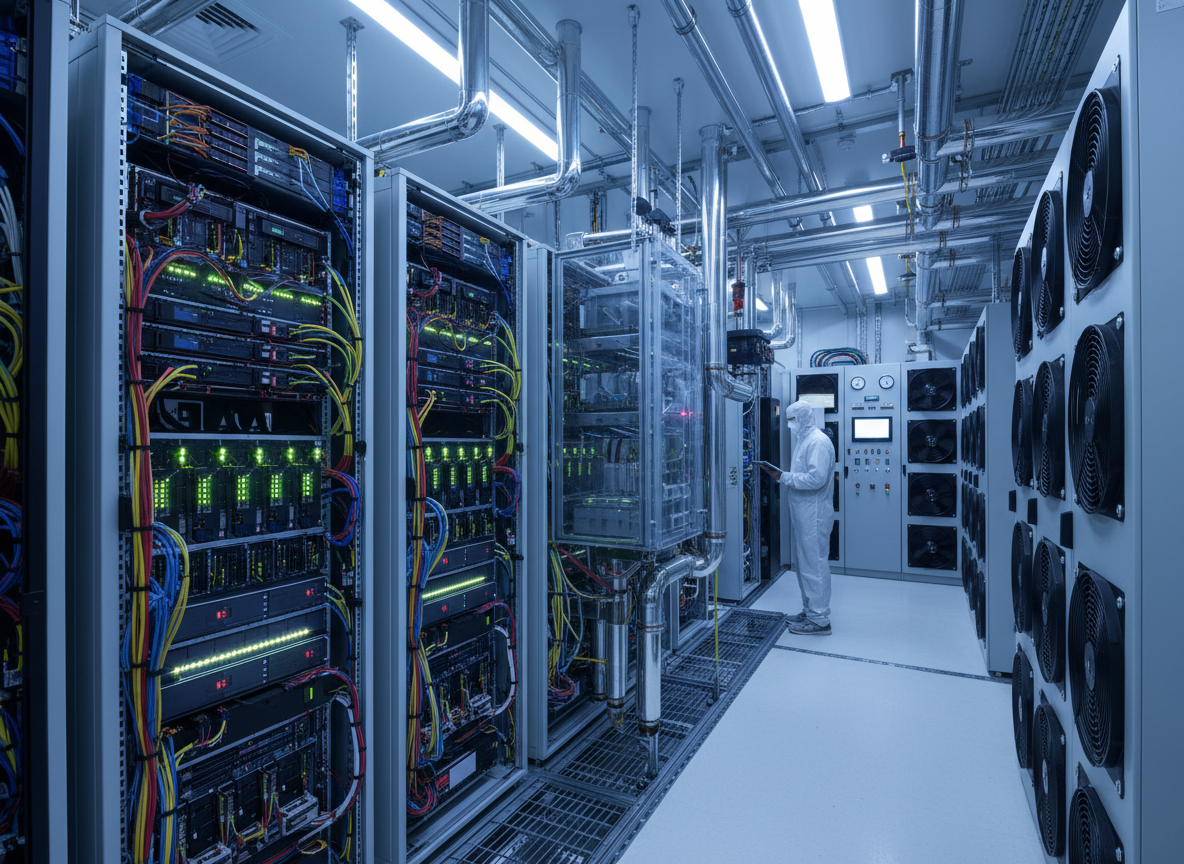
High-density AI/HPC deployments necessitate advanced cooling strategies capable of managing thermal loads that frequently exceed 50 kW per rack, and in some cutting-edge instances, can approach or even surpass 100 kW per rack. This represents a significant departure from traditional enterprise data centers, where average rack densities might range from 5 kW to 15 kW. The fundamental requirement is to efficiently remove concentrated heat generated by powerful GPUs and CPUs, maintaining component temperatures within specified operational limits to ensure performance, reliability, and longevity. Failure to implement robust and scalable cooling can lead to thermal throttling, system instability, and premature hardware failure, directly impacting the return on investment for these compute-intensive infrastructures.
Understanding Thermal Load in AI/HPC Environments
The primary driver for specialized cooling in AI/HPC is the sheer density of power consumption within a small physical footprint. Modern AI accelerators and HPC processors consume substantial power, converting a significant portion of that electrical energy directly into heat. For example, a single server chassis populated with multiple NVIDIA H100 GPUs can easily draw 10 kW to 15 kW, and a rack housing four to six such servers can quickly reach 40 kW to 90 kW. This concentrated heat generation demands a cooling solution that can target specific heat sources effectively. Unlike traditional air-cooled environments where heat is dispersed more broadly, AI/HPC racks create localized hotspots that overwhelm conventional CRAC/CRAH units. The cooling infrastructure must be designed from the outset to handle these extreme thermal envelopes.
The challenge is compounded by the continuous, high-utilization nature of AI/HPC workloads. These systems are often running at or near peak capacity for extended periods, generating consistent, intense heat loads. This contrasts with more variable enterprise workloads, which might have fluctuating power demands. Therefore, the cooling system must offer not just peak capacity, but also sustained, reliable performance without degradation. Understanding the specific power draw of chosen hardware, including GPUs, CPUs, memory, and networking components, is the first step in accurately sizing the cooling infrastructure. Overlooking even small details in the thermal budget can lead to significant cooling deficits down the line.
Air-Based Cooling Limitations and Enhancements
While traditional air-based cooling systems, such as Computer Room Air Conditioners (CRACs) and Computer Room Air Handlers (CRAHs), remain foundational in many data centers, their effectiveness diminishes rapidly as rack densities climb above 20 kW. At higher AI/HPC densities, the volumetric airflow required to dissipate heat becomes impractical, leading to hot spots, recirculation, and inefficient cooling. Even with advancements like hot aisle/cold aisle containment and in-row cooling units, air's lower thermal conductivity and heat capacity compared to liquid make it less efficient for extreme densities.
To push the boundaries of air-cooling for moderately dense AI/HPC, strategies like direct-to-chip air cooling with specialized server designs and highly efficient fans are sometimes employed. However, these often require significant compromises in server form factor or lead to increased fan power consumption. For densities exceeding 30 kW per rack, air-based cooling typically becomes economically and physically unfeasible. The energy required to move sufficient air volume through dense server racks at high static pressures becomes prohibitive, driving up operational costs and consuming valuable rack space for cooling infrastructure rather than compute equipment. This limitation is a primary reason for the shift towards liquid-based solutions.
The Inevitable Shift to Liquid Cooling
For AI/HPC deployments pushing beyond 30-40 kW per rack, liquid cooling becomes not just an option, but a necessity. Liquid has a significantly higher thermal conductivity and heat capacity than air, enabling much more efficient heat transfer and removal. There are two primary categories of liquid cooling: direct-to-chip liquid cooling and immersion cooling.
Direct-to-chip liquid cooling, also known as cold plate cooling, involves circulating a dielectric fluid directly over or through cold plates attached to high-heat-generating components like CPUs and GPUs. This method captures heat very close to its source, preventing it from entering the ambient air of the data hall. The heated liquid is then routed to a Cooling and Mechanical Module or a heat exchanger, where the heat is transferred to a facility water loop or rejected to the outside. This approach allows for significantly higher rack densities, often supporting 50 kW to 100 kW per rack, while still maintaining a relatively familiar rack-based form factor. Many modern AI servers are now designed with integrated liquid cooling loops, simplifying deployment.
Immersion Cooling: Maximizing Density and Efficiency
Immersion cooling represents the pinnacle of high-density thermal management, offering the highest potential for heat removal per unit volume. In this method, server components or entire servers are submerged directly into a non-conductive dielectric fluid. This fluid, typically a mineral oil or synthetic fluid, directly absorbs heat from all submerged components, providing extremely efficient and uniform cooling. There are two main types: single-phase immersion and two-phase immersion.