2026-09-16 ·
Liquid Cooling Considerations for Modular Deployments
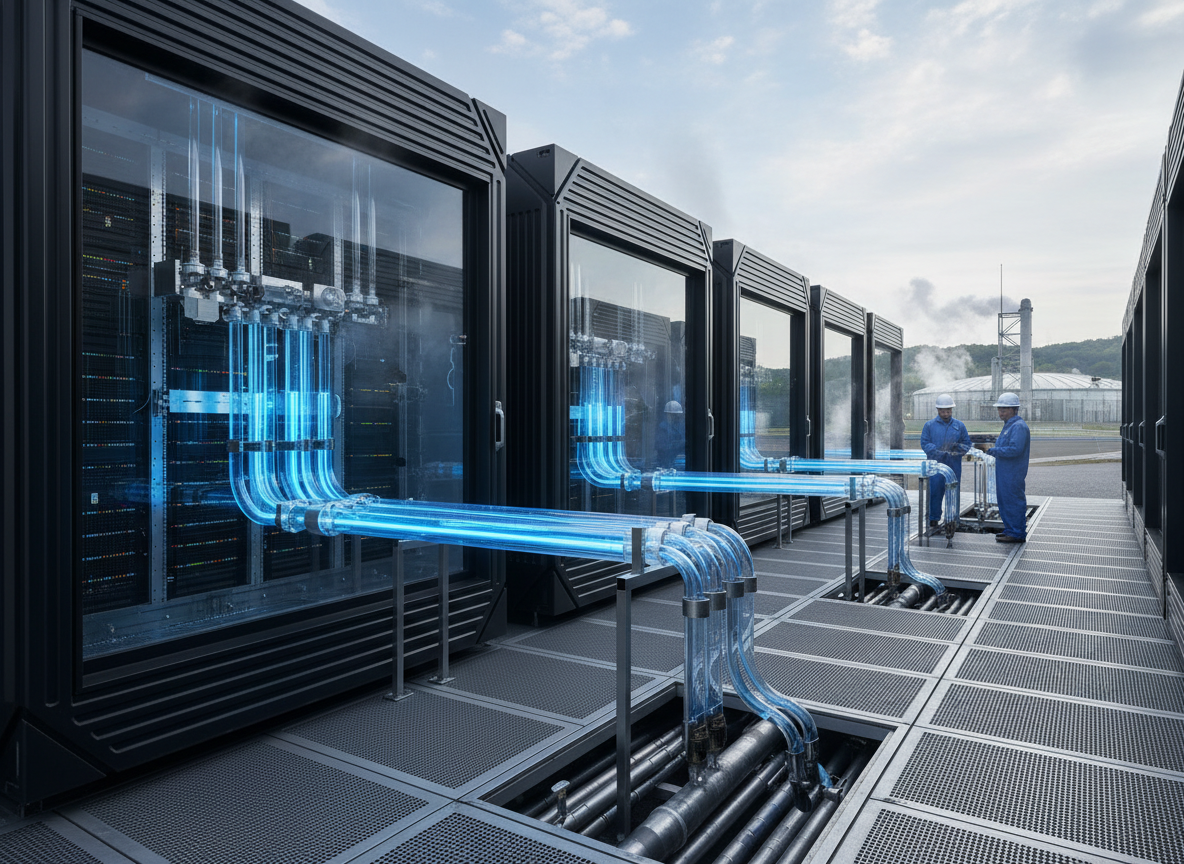
Liquid cooling is increasingly vital for high-density modular data center deployments, offering significant advantages over traditional air cooling in terms of thermal management and energy efficiency. The primary considerations revolve around selecting the appropriate liquid cooling technology—whether direct-to-chip, immersion, or rear-door heat exchangers—based on workload density, infrastructure compatibility, and long-term operational goals. Each method presents distinct benefits and challenges, impacting everything from fluid management and leakage detection to power usage effectiveness (PUE) and total cost of ownership (TCO). Understanding these nuances is crucial for optimizing the thermal performance and scalability of modular data center solutions, particularly as rack power densities consistently push beyond 30 kW per rack in many modern deployments, making air-cooling solutions less effective and more space-intensive.
Direct-to-Chip Cooling Integration
Integrating direct-to-chip liquid cooling within a modular data center framework requires careful planning, particularly concerning the distribution of coolant and the management of heat rejection. This method involves circulating a dielectric fluid directly over or through hot components like CPUs and GPUs, capturing heat at its source. For modular deployments, this often translates into specialized server racks designed to accommodate the necessary plumbing for coolant delivery and return. The primary benefit is the exceptional thermal transfer capability, allowing for extremely high-density racks—often exceeding 50 kW—without the need for extensive air-handling infrastructure. Considerations include the selection of appropriate quick-disconnect couplings to facilitate hot-swapping components, the materials compatibility of the cooling loop with various server components, and the integration of leak detection systems within the module to prevent potential damage. The modular nature of these systems means that entire cooling loops and their associated heat rejection units can be pre-integrated into a <a href="/services/cooling-and-mechanical-modules">cooling and mechanical module</a>, simplifying deployment.
Immersion Cooling Architectures
Immersion cooling, both single-phase and two-phase, represents a significant departure from traditional cooling paradigms and offers compelling advantages for ultra-high-density modular data centers. In single-phase immersion, servers are submerged in a dielectric fluid that remains in liquid form, transferring heat through convection. Two-phase immersion uses a fluid with a lower boiling point, allowing it to vaporize upon contact with hot components, rise, condense on a cold plate, and return as liquid. Both approaches eliminate the need for server fans, reducing noise, vibration, and energy consumption associated with air movement. For modular deployments, immersion tanks can be integrated directly into specialized <a href="/services/integrated-modular-data-centers">integrated modular data centers</a>, offering a self-contained, high-performance computing environment. Key considerations include the choice of dielectric fluid, tank design for ease of maintenance and server access, and the overall footprint of the immersion tanks within the modular structure. The fluid management system, including filtration and potential replenishment, also needs robust integration to ensure long-term operational stability.
Rear-Door Heat Exchangers in Modular Units
Rear-door heat exchangers (RDHX) offer a less disruptive but still highly effective liquid cooling solution for modular data centers, particularly when transitioning from air-cooled environments or managing moderate to high-density racks (15–30 kW). These units replace the standard rear door of a server rack with a heat exchanger coil through which chilled water or a refrigerant circulates. As hot air exits the servers, it passes through the coil, where heat is transferred to the liquid, and cooled air is returned to the data center aisle. This method effectively isolates the heat load at the rack level, preventing hot spots and reducing the overall cooling demand on the facility's main HVAC system. For modular deployments, RDHX units can be factory-integrated into <a href="/services/data-center-expansion-modules">data center expansion modules</a> or modular data halls, ensuring proper sealing and plumbing connections are established prior to deployment. Considerations include the availability of chilled water, the potential for condensation if dew points are not managed, and the integration of robust leak detection and containment strategies to safeguard IT equipment.
Fluid Management and Leak Detection
Regardless of the liquid cooling technology chosen, robust fluid management and leak detection systems are paramount in modular data center deployments. The integrity of the cooling loop is critical, and any compromise can lead to significant downtime and equipment damage. This involves careful selection of piping materials (e.g., stainless steel, PEX, CPVC) and connection types (e.g., quick-disconnects, welded joints) to minimize potential failure points. For direct-to-chip and immersion systems, the use of dielectric fluids reduces the risk of electrical shorts in the event of a leak, but the potential for fluid loss and environmental impact still necessitates proactive measures. Integrated leak detection sensors, often utilizing optical or conductive technologies, should be strategically placed at critical connection points, under racks, and within containment areas. These sensors should be linked to the data center's building management system (BMS) to trigger immediate alerts and automated shutdown procedures if a leak is detected. Regular maintenance and inspection protocols for all fluid-carrying components are also essential to prevent issues before they escalate, ensuring the long-term reliability of the modular infrastructure.
Energy Efficiency and PUE Optimization
One of the most compelling drivers for adopting liquid cooling in modular data centers is the potential for significant energy efficiency gains and PUE optimization. Liquid has a much higher thermal conductivity and specific heat capacity than air, meaning it can transfer heat far more efficiently. This allows liquid cooling systems to remove greater heat loads with less energy input compared to traditional air-based cooling. For example, direct-to-chip and immersion cooling can virtually eliminate the energy consumed by server fans and reduce the overall airflow requirements within the module, leading to lower fan power and chiller loads. Rear-door heat exchangers, while still relying on some air movement, localize heat removal and reduce the amount of conditioned air needed to cool the IT space. By integrating these efficient cooling methods, modular data centers can achieve PUEs well below 1.2, even in challenging environments. The ability to utilize warmer return water temperatures from liquid cooling systems also opens opportunities for free cooling with dry coolers or cooling towers in regions with suitable climates, further enhancing energy savings and reducing operational costs over the lifecycle of the modular deployment. This focus on efficiency is a core benefit of modular construction, as highlighted in <a href="/blog/when-modularization-makes-sense-for-data