2026-09-16 ·
UPS Infrastructure Planning for Modular Deployments
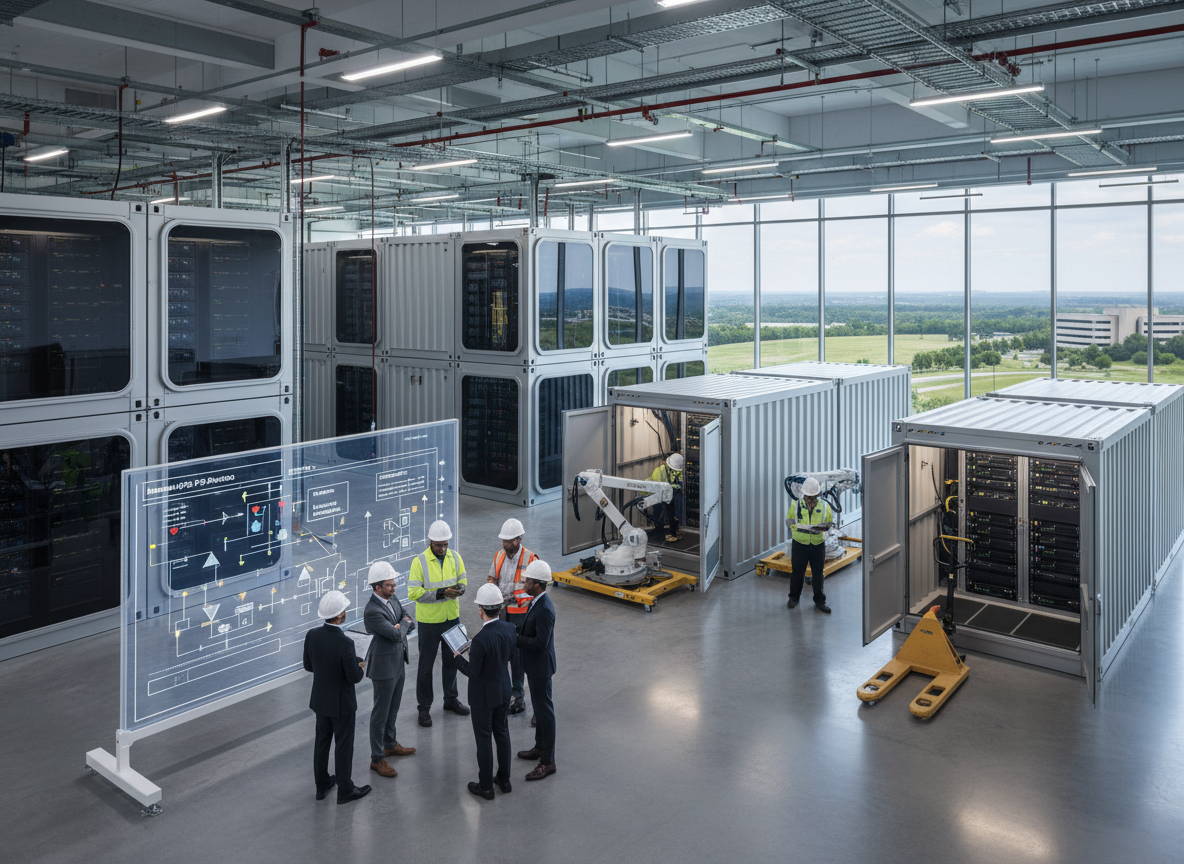
UPS infrastructure planning for modular data center deployments requires a nuanced approach, prioritizing both immediate operational needs and future scalability. The optimal strategy often involves a combination of modular UPS units, scalable battery solutions, and a robust power distribution architecture designed for phased expansion. Key considerations include the choice between centralized and distributed UPS topologies, the selection of appropriate battery chemistries like VRLA or Li-ion, and the implementation of N+1 or 2N redundancy schemes to ensure continuous power delivery. The upfront planning should account for the entire lifecycle, from initial deployment to future capacity upgrades, ensuring seamless integration with other modular components such as power distribution modules and cooling infrastructure. For example, in a rapidly expanding market like Singapore, where land is at a premium, modular UPS solutions allow for efficient use of space and rapid deployment, aligning with the agile demands of hyperscale and colocation providers. Similarly, in a region with grid instability, such as parts of Mumbai, a resilient UPS strategy within a modular framework is critical to maintaining uptime.
Evaluating UPS Topologies for Modular Designs
Selecting the appropriate UPS topology is a foundational decision in modular data center planning. Two primary approaches dominate: centralized and distributed. A centralized UPS system typically involves a large, single or parallel array of UPS units feeding an entire data hall or multiple modules. This can offer economies of scale in maintenance and management but introduces a single point of failure risk if not properly redundant. Conversely, a distributed UPS approach places smaller UPS units closer to the IT load, often within individual racks or modules. This enhances fault isolation, as a failure in one UPS impacts only a localized section, improving overall system resilience. For <a href="/services/integrated-modular-data-centers">integrated modular data centers</a>, a distributed approach can be particularly advantageous, allowing each module to operate with its own power protection, simplifying expansion. Consider a scenario in a market like London, where real estate costs drive compact designs; a distributed UPS within each <a href="/services/modular-data-halls">modular data hall</a> could maximize white space utilization while maintaining high availability. The choice depends heavily on the project's specific redundancy requirements, physical footprint constraints, and long-term scalability goals.
Battery Technology Selection and Sizing
The choice of battery technology significantly impacts the UPS system's performance, footprint, and total cost of ownership. Valve-Regulated Lead-Acid (VRLA) batteries remain a common choice due to their proven reliability and lower initial cost. However, their shorter lifespan (typically 5–10 years) and sensitivity to temperature fluctuations necessitate more frequent replacement and controlled environments. In contrast, Lithium-ion (Li-ion) batteries offer a longer lifespan (10–15 years or more), higher energy density, faster recharge times, and better performance across a wider temperature range. While their upfront cost is higher, the reduced maintenance, extended life, and smaller footprint often result in a lower total cost of ownership over the data center's operational life. For instance, in a large-scale deployment in Dallas-Fort Worth, where rapid capacity expansion is common, the smaller footprint and longer life of Li-ion batteries can accelerate deployment timelines and reduce operational overhead. Sizing involves calculating the total critical load, desired runtime (typically 5–15 minutes for most data centers, allowing generators to start), and future expansion plans, always factoring in battery degradation over time.
Redundancy Schemes and Scalability
Implementing robust redundancy schemes is critical for maintaining uptime in modular data centers. Common configurations include N+1 and 2N. An N+1 system provides one extra UPS module beyond what is strictly required to support the critical load, offering protection against a single component failure. This is often a cost-effective balance between resilience and capital expenditure. A 2N (fully redundant) system duplicates the entire power path, providing two independent UPS systems, each capable of supporting the full critical load. This offers the highest level of fault tolerance but comes with significantly higher costs and space requirements. For <a href="/services/data-center-expansion-modules">data center expansion modules</a>, the chosen redundancy must align with the overall facility's Uptime Institute tier classification objectives. Scalability is achieved by designing the UPS infrastructure to allow for the addition of units or expansion of battery strings without disrupting live operations. This often involves modular UPS units that can be hot-swapped or added in parallel. Consider a data center operator in Silicon Valley planning for phased growth; a modular UPS system with N+1 redundancy, designed for seamless addition of further N+1 blocks, allows them to scale power capacity in alignment with IT load growth, minimizing initial investment while ensuri
Integration with Power Distribution and Cooling
Effective UPS planning extends beyond the UPS units themselves to their seamless integration with the broader power distribution and cooling infrastructure. The UPS output must feed into a meticulously designed power distribution system, often involving <a href="/services/power-distribution-modules">power distribution modules</a> (PDMs) and switchgear, to deliver conditioned power to the IT equipment. This integration requires careful consideration of cable routing, busbar systems, and protective devices to prevent single points of failure. Similarly, the heat generated by UPS units and their associated batteries necessitates dedicated cooling solutions. While VRLA batteries require strict temperature control, Li-ion batteries exhibit greater thermal tolerance, potentially simplifying cooling requirements. However, proper ventilation and thermal management within <a href="/services/ups-and-battery-rooms">UPS and battery rooms</a> are always essential to ensure optimal performance and longevity. In a market like Frankfurt, known for its stringent energy efficiency standards, optimizing the integration between UPS, PDMs, and cooling systems within a modular framework is paramount to achieving desired PUE targets and operational sustainability.
Future-Proofing and Lifecycle Management
Designing UPS infrastructure for modular deployments also involves a strong emphasis on future-proofing and comprehensive lifecycle management. Technology evolves rapidly, and the modular nature of the data center should allow for future upgrades to UPS units or battery technologies without requiring a complete overhaul of the power infrastructure. This includes specifying open architectures, standard interfaces, and sufficient physical space for future equipment. Lifecycle management encompasses proactive maintenance schedules, monitoring systems for battery health and UPS performance, and planning for end-of-life replacement. For example, in a long-term project in Sydney, where data center lifecycles can span decades, selecting a UPS vendor with a clear roadmap for future product compatibility and robust support services becomes a critical factor. Furthermore, considering the environmental impact of battery disposal and exploring options for recycling or repurposing aligns with modern sustainability goals. This forward-thinking approach ensures that the UPS infrastructure remains reliable and adaptable throughout the data center's operational lifespan, providing a stable foundation for evolving IT demands. For further insights into strategic modular deployment, consider reading our article on <a href="/blog/when-modularization-makes-sense-for-data-center-projects">When Modula