Germany's data center market is anchored by Frankfurt, home to one of the world's largest internet exchange points and a primary interconnection hub for continental Europe, with growing activity in Berlin, Munich, Hamburg, and other regions. This page provides a national view of the German modular infrastructure market; for Frankfurt-specific detail, see our Frankfurt page.
National Market Context and Development Regions
Frankfurt's role as a core interconnection point has made land and grid capacity in the immediate metro area increasingly constrained, a factor that has pushed some new development toward other German regions. Germany's broader industrial base, strong fiber infrastructure, and central European location support data center demand well beyond the Frankfurt metro, including enterprise and colocation growth in southern and northern Germany.
Power and Electrical Infrastructure
Germany's ongoing energy transition and industrial grid capacity are both factors project teams weigh in site selection, and Germany has introduced energy-efficiency and reporting requirements that apply to data center operations. Specific compliance obligations are project- and jurisdiction-specific and remain the responsibility of the buyer's local engineering and legal teams. Modular electrical buildings, switchgear buildings, and power distribution modules can be configured to the voltage and distribution architecture a project specifies.
Cooling and High-Density Compute
German data center design has long emphasized energy efficiency, and this continues to shape cooling strategy as rack densities rise with AI and HPC adoption. Cooling and mechanical modules and liquid cooling infrastructure modules can be configured for air, liquid, or hybrid strategies depending on the density and efficiency targets set by the project's mechanical engineers.
AI/HPC, Hyperscale, Colocation, and Enterprise Demand
Germany's market includes a strong base of enterprise and industrial compute demand alongside hyperscale and colocation capacity concentrated in Frankfurt, plus growing AI/HPC-focused deployments. AI and HPC modular infrastructure can be configured around the rack densities and cooling strategy specified for these workloads.
Modular Deployment at National Program Scale
For operators expanding across multiple German regions rather than a single site, modular delivery supports standardized building and electrical specifications that can be repeated with regional adaptation. See multi-building data center infrastructure and data center expansion modules.
Logistics and International Delivery
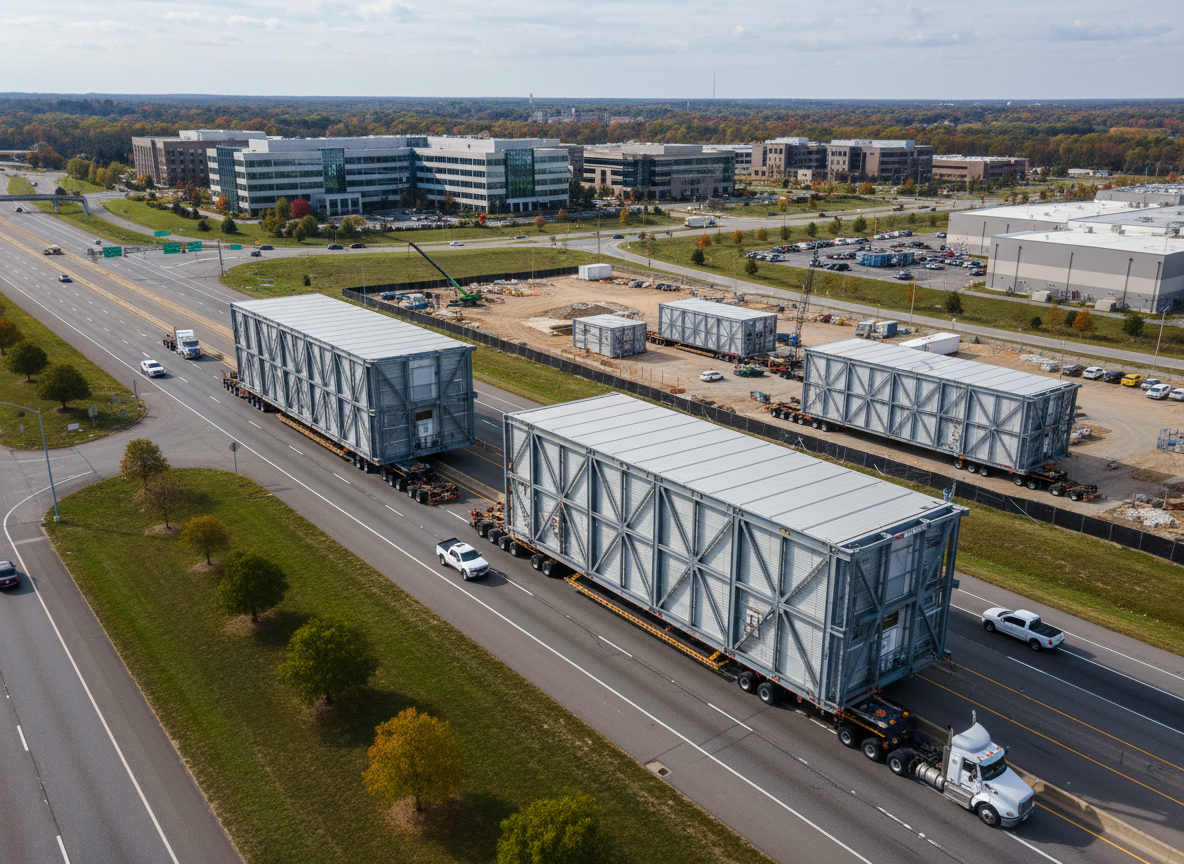
Germany's central position within continental Europe supports efficient road-based delivery of modular components to sites throughout the country and into neighboring markets; the specific transport mode depends on module dimensions, manufacturing origin, and site access requirements. See international shipping considerations for modular infrastructure and understanding module dimensions and transport limits.
Data Center Modular manufactures modular infrastructure to the specifications of buyers and project teams throughout Germany. Local permitting, site preparation, foundations, grid connection, and installation remain the responsibility of the project's local team and contractors. For Frankfurt-specific market detail, see our Frankfurt page.
Modular Data Center in Germany — Local Notes
- •Frankfurt's role as a major European interconnection point has made land and grid capacity in the immediate metro area increasingly constrained, a factor influencing some new development toward other German regions.
- •Germany has introduced energy-efficiency and reporting requirements affecting data center operations; specific compliance obligations are project- and jurisdiction-specific and are the responsibility of the buyer's local engineering and legal teams.
- •Germany's central location within continental Europe supports efficient delivery of modular components to sites throughout the country and neighboring markets, with transport mode determined case by case.