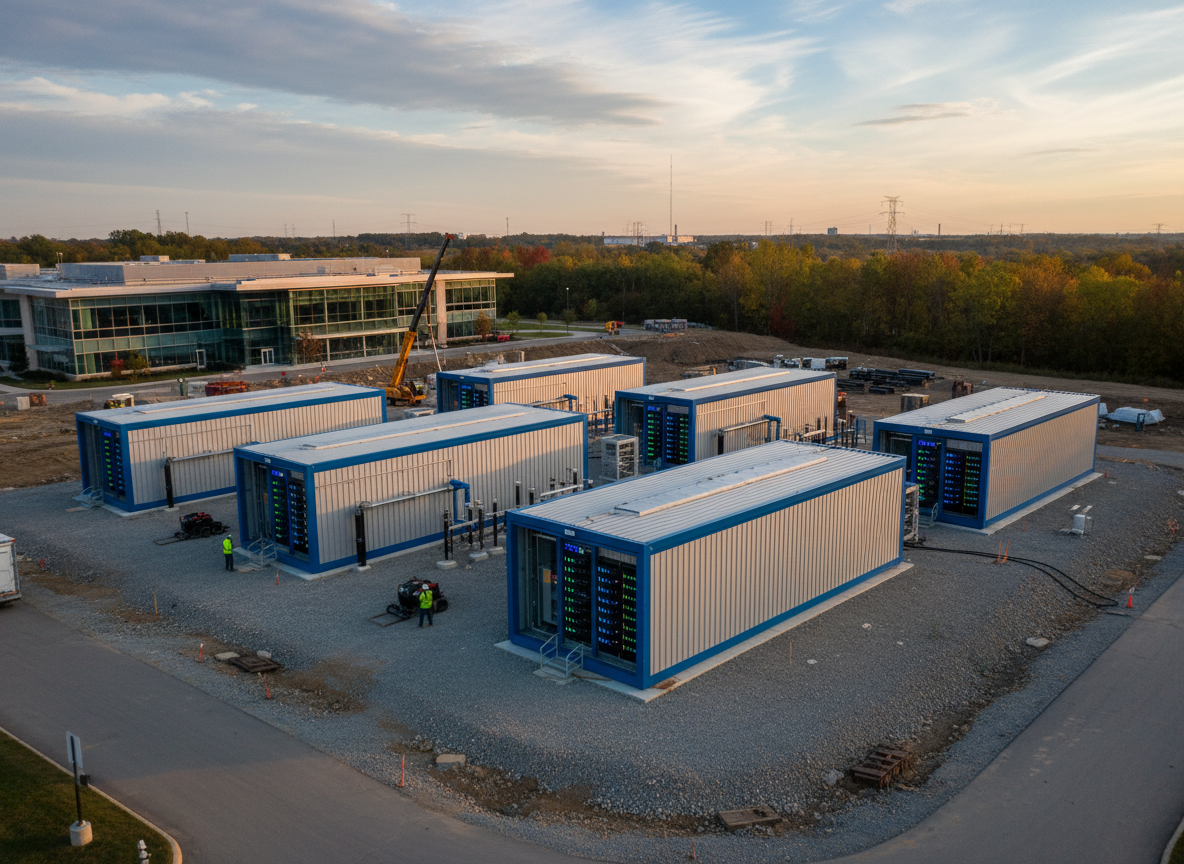
The United States is home to the world's largest concentration of data center capacity, spanning long-established hubs such as Northern Virginia alongside a growing set of secondary and tertiary markets across the country. This page provides a national view of the U.S. modular infrastructure market; for metro-specific detail, see the individual market pages linked below.
National Market Context and Development Regions
Northern Virginia remains the single largest concentration of data center capacity globally, and the U.S. market also includes major secondary hubs such as Dallas-Fort Worth, Phoenix, Atlanta, Chicago, Columbus, Salt Lake City, Hillsboro and Portland, Silicon Valley, and Austin. As land and power availability in established markets tighten, development activity continues to spread into additional U.S. regions.
Power and Electrical Infrastructure
Grid interconnection queue timelines and power availability have become a central constraint on U.S. data center development in many regions, a factor widely reported across multiple grid operators and utility territories. This has increased interest in markets with more available capacity and in modular electrical infrastructure that can help parallelize on-site construction once power is secured. Modular electrical buildings, switchgear buildings, power distribution modules, and UPS and battery rooms can be configured to the voltage and redundancy architecture a project specifies.
Cooling and High-Density Compute
The U.S. spans a wide range of climates, from the humid Southeast to the arid Southwest and colder northern regions, and cooling strategy varies accordingly by market. The rapid growth of AI and HPC workloads nationally has significantly increased demand for high-density, liquid-cooling-ready infrastructure. Cooling and mechanical modules and liquid cooling infrastructure modules can be configured to the density and climate strategy specified for a given site.
AI/HPC, Hyperscale, Colocation, Cloud, Enterprise, Edge, and Telecom Demand
The U.S. market spans essentially every data center use case at scale: hyperscale cloud regions, wholesale and retail colocation, enterprise and telecom infrastructure, and a rapidly growing base of AI/HPC-focused compute clusters, alongside edge deployments supporting latency-sensitive applications nationwide. AI and HPC modular infrastructure, edge data centers, and micro data centers can be configured to this full range of requirements.
Modular Deployment at National Program Scale
For operators running multi-site rollout programs across several U.S. markets, modular delivery supports standardized specifications with regional adaptation for climate, power source, and local code requirements. See multi-building data center infrastructure and data center expansion modules.
Logistics and International Delivery
The scale and geographic spread of the U.S. market make transport planning and module logistics a significant part of project scheduling, whether components originate domestically or internationally. See transportation planning for modular data center buildings, understanding module dimensions and transport limits, and site access planning for modular deliveries.
Data Center Modular manufactures modular infrastructure to the specifications of buyers and project teams throughout the United States. Local permitting, grid interconnection, site preparation, foundations, and installation remain the responsibility of the project's local team and contractors. See the metro pages above for market-specific detail on any of our covered U.S. regions.
Modular Data Center in the United States — Local Notes
- •Grid interconnection queue timelines and power availability have become a central constraint on U.S. data center development in many regions, a widely reported factor across multiple utility territories.
- •Climate varies significantly across U.S. markets, from the humid Southeast to the arid Southwest and colder northern regions, and this should inform cooling-strategy discussions with your mechanical engineers.
- •Local permitting, zoning, and grid interconnection processes vary by state, county, and utility territory, and are the responsibility of the project's local team.